domenica 17 aprile 2016

Vettovaglie, carriaggi e trasporti vari... Victuals , wagons and various transport ...

Un esercito non esisterebbe senza i trasporti che gli assicurano vitto e riparo per la notte. Dunque, anche per i miei eserciti in piombo ho preparato un pò di trasporti.


Il carro trainato dai buoi è della Perry: pur essendo molto bello devo avvisarvi che è piuttosto complicato da assemblare e dipingere. In pratica bisogna dipingere tutti i pezzi prima di montarli, altimenti, dopo,  diventa impossibile.


I muli con i conducenti sono della ditta romana Strategia Nuova.
 In realtà sono venduti come medievali, ma penso che le differenze siano tollerabili.


Gli uomini in marcia sono della Redoubt Enterprise.

An army would not exist without the transport that provide food and shelter for the night. 
Therefore, even for my armies in lead I made some transport.


The ox cart is from the Perry minis: although very nice I must warn you that it is quite complicated to assemble and paint . In practice you have to paint all the pieces before assempling them ; otherwise , later, becomes impossible .

The mules with drivers are the Roman company Strategia Nuova.  Actually they are sold as medieval , but I think the differences are tolerable .

Marching men are from Redoubt Enterprises


domenica 13 marzo 2016

Un giorno allo Stibbert - A day at the Stibbert Museum

La sala del Condottiero - The Condottiero hall
Finalmente, ieri sono riuscito a fare una cosa che desideravo da tanto tempo. Ho approfittato di una giornata a Firenze per visitare il Museo Stibbert, una delle collezioni d'armi (e di tanto altro) più grandi in Italia e, probabilmente, al mondo.

Situato su una collina  ed immerso in un grande e magnifico parco, il museo è custodito all'interno della casa che la famiglia Stibbert fece ampliare e ricostruire alla metà dell'800 in stile neogotico.
Già l'edificio è impressionante, sia all'interno che all'esterno, ma la collezione d'armi che vi è ospitata lascia assolutamente senza fiato!!! Oltre a cimeli di vari periodi (anche napoleonici: ci sono, tra gli altri, il manto che Napoleone indossava durante la sua incoronazione a Re d'Italia ed una sciabola di Gioacchino Murat) le collezioni del periodo rinascimentale sono meravigliose. La sala detta "della cavalcata" non ha nulla da invidiare all'analoga sala al Metropolitan Museum di New York, anzi forse è anche più bella, sicuramente più suggestiva. Armi ed armature delle Guerre d'Italia sono indossate da manichini e custodite in enormi teche.
La sala della Cavalcata
La cavalcata al Metropolitan Museum di New York


Armature ottomane 
 Anche la collezione "orientale" di armi ottomane ed indiane del periodo Moghul è fantastica (anche se adesso la sala principale è chiusa per restauro).

Collezione di armi Indiane


Una piccola parte della collezione di armi da fuoco.
Nella teca sotto, la sciabola di Murat


Il manto di Napoleone I

La ricostruzione di un'armatura italiana del '300 fatta
fare da Sibbert per partecipare ad un corteo storico a Firenze

Il personale è preparatissimo a tutte le domanda gli facciate durante la visita guidata che dura circa un ora e venti.
Persino il bookshop è ben fornito con libri e souvenirs. Insomma, un Museo che meriterebbe più gloria (e finanziamenti) e che molti paesi esteri ci invidierebbe.
L'unico rimpianto è stato di non poter visitare la collezione giapponese, la più grande collezione di armature e spade da samurai che si trovi al di fuori del Giappone. C'è bisogno di prenotazione e solo in orari prestabiliti: ma tornerò a vederla, non posso mancarla...


Finally, yesterday I managed to do something that I wanted for so long. I took advantage of a day in Florence to visit the Stibbert Museum, one of the largest collection of arms (and much more), in the Italy and probably the world.

Set on a hill and surrounded by a large and beautiful park, the museum is housed inside the house that the Stibbert family had it enlarged and rebuild the middle of 800 in neo-Gothic style.

Already the building is impressive, both inside and outside, but the collection of weapons leaves absolutely breathless !!! As well as memorabilia from various periods (even Napoleonic: there are, among others, the mantle that Napoleon wore during his coronation as King of Italy and one among Joachim Murat’s saber) the collections of the Renaissance period is wonderful. The room called "the ride" has nothing to envy to the similar room at the Metropolitan Museum in New York, or perhaps it is more beautiful, certainly more impressive. Weapons and armor of the Italian Wars are worn by mannequins and stored in huge glass cases.
Even the "Oriental" collection of Ottoman and Indian weapons of the Mughal period is fantastic (even if the main hall is now closed for renovation).

The staff is well-trained in all the question during a guided tour that lasts about an hour and twenty.

Even the bookshop is well stocked with books and souvenirs. In short, a museum that deserves more glory (and funding) and that many foreign countries envy us.

The only regret was that I could not visit the Japanese collection, the largest collection of samurai armor and swords outside of Japan. One need to book the visit and only at fixed times: but I will return to see it, I can not miss it ...


martedì 8 marzo 2016

Lame Estensi - Este's blades


Li avevo da lungo tempo nella scatola. Era ora di dipingerli. La prima unità di "spadaccini" italiani, unità scelte e rinomate in tutta Europa.
Per la scelta dei colori e delle araldiche, ho deciso di dedicare ciascuna base a 4 delle contrade di Ferrara.
I pezzi sono tutti Perry Miniatures.


Santa Maria in Vado
Santo Spirito
San Benedetto


San Giorgio


I had them for a long time in the box. It was time to paint them. The first unit of  Italian "swordsmen ", chosen and famous units across Europe .
For the choice of colors and heraldic, I decided to dedicate each base to 4 of the "Contrade" of Ferrara .
Miniatures are all from Perry Miniatures.

sabato 27 febbraio 2016

Las colunellas

Dunque, ecco qua le prime due unità spagnole del periodo. Si tratta in realtà di spagnoli del regno di Napoli, che indossano elmi assai particolari.

La formazione è quella nota come Colunella, che comprendeva picchieri, archibugieri e fanti armati di spada e scudo, in proporzione 2:1:2 (o, in qualche caso solo da picchieri). Trovate indicazioni dettagliate a questo link, in spagnolo. 
Una Colunela grande

Ho realizzato due tipi di Colunella, uno più grande con 4 basi di picchieri e 2 ciascuna di archibugieri e spadaccini, ed una più piccola con 2 basi per ciascun tipo.
Una Colunela piccola
Questo tipo di imbasettamento consente comunque di raggruppare le basi per tipo per formare unità uniformi (a seconda del regolamento).
Le basi comando

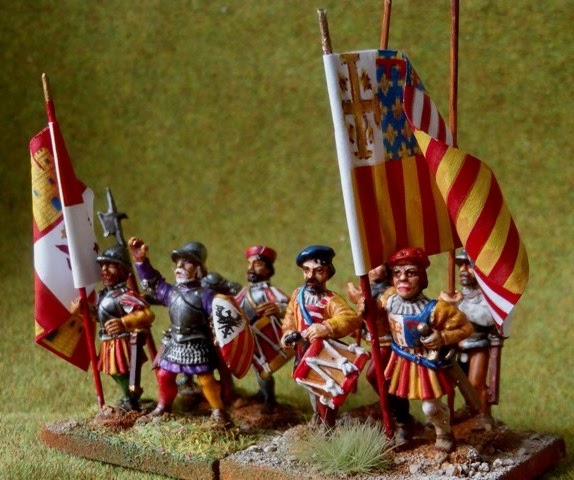
I pezzi sono della Assault group, con qualche "spadaccino" della Wargame Foundry.


Moschettieri

Sword & Bucklers


So, here are the first two Spanish units for the period . These are actually from the Spanish kingdom of Naples and the men wear very particular helmets . The formation is known as Colunella , which included pikemen , musketeers and infantry armed with sword and shield, in proportion 2 : 1 : 2 (or , in some cases only by pikemen ) . You can find further information at this link , in Spanish. I made two types of Colunella, one larger with 4 bases of pikemen and 2 each of musketeers and swordsmen, and a smaller one with 2 bases for each type . This basing still allows you to group the bases by type to form uniform units (for the different rule sets) . The miniatures are from the Assault group, with some " swordsman " from Wargame Foundry .

martedì 15 dicembre 2015

Marignano! Finalmente!!!


Il tavolo di gioco: sulla destra le colonne svizzere, a sinistra, dietro il fossato l'avanguardia francese e, sulla collina, il corpo principale al comando del Re

E allora, alla fine, ce l'abbiamo fatta! Giusto in tempo per festeggiare il 500° anniversario della Battaglia dei Giganti, domenica scorsa al Miles Gloriosus abbiamo ri-combattuto la battaglia che segnò la fine della dominazione svizzera sul Ducato di Milano e la vittoria definitiva del giovane re di Francia, Francesco I.

Abbiamo scelto di utilizzare il regolamento Pike & Shotte con alcune varianti (riportate su questo stesso blog in una pagina a parte).
Il regolamento ha "girato" molto bene e siamo riusciti a fare tantissime mosse: lo scontro ci ha impegnato per circa 5 ore (oltre ad una sontuosa pausa pranzo al ristorante giapponese...).
Hanno partecipato 7 giocatori oltre all'arbitro.
Il corpo principale francese con i gendarmi e la banda nera dei Lanzi.
 Gli army lists li trovate in un'altra pagina, sempre su questo blog.


Le colonne svizzere avanzano
Com'è andata? Storicamente, direi. Le tre colonne principali svizzere sono avanzte sopportando il tiro delle artiglierie francesi fino al fossato, per impegnare il quadrato di picchieri francesi che, nonostante le scarse aspettative, si è comportato assai gagliardamente prima di cedere il passo. nel frattempo, mentre i gendarmi francesi  calpestavano duramente le poche cavallerie pesanti milanesi, sull'altra ala le cavallerie leggere francesi tenevano impegnata l'avanguardia svizzera formata da tiratori e alabardieri. Finalmente, sull'ala sinistra svizzera una piccola unità di cavalleria leggera riusciva a prendere sul fianco le artiglierie reali allegerendo la pressione sulla colonna di picchieri più esposta che riusciva a resistere solo grazie all'incoraggiamento del cardinal Schinner.

Travolta l'avanguardia francese, le colonne svizzere si trovano con un bel pò di perdite subite ed attaccate dai gendarmi francesi da tutte le parti. La colonna di destra si scontra con i Lanzi delle Bande Nere e dopo un breve ma furiosissimo combattimento (Ah, la Mala guerra!), lo mettono in fuga.

Ma sulla sinistra la situazione è ben più drammatica: il quadrato svizzero è attaccato ad ondate e contemporaneamente più e più volte dalla Gendarmeria e, alla fine, soccombe e rompe!

A quel punto, cala la sera, gli svizzeri si rendono conto che non riusciranno a raggiungere il campo avversario prima della notte e, anche se ci riuscissero, troverebbero la retroguardia francese, non ancora impegnata ad attenderli. Quindi, inizia la ritirata verso le proprie linee, chissà, forse per riattaccare domani.

A sinistra, i picchieri francesi contrastano bravamente l'assalto confederato
Insomma, proprio come andò 500 anni fa!


Il quadrato di picchieri Lanzi

Una foresta di picche!

La gendarmeria del re si prepara ad avanzare

I Gendarmi del corpo principale francese cominciano a scendere dalla collina, mentre quelli del Borbone si predispongono ad attaccare il retro della colonna svizzera di sinistra.

Clash! Il riccio svizzero viene attaccato su due fronti dalla migliore cavalleria d'Europa!
*************


And then , finally , we did it ! Last Sunday, just in time to celebrate the 500th anniversary
 of the Battle of the Giants, at the Miles Gloriosus Club we re - fought the battle that marked the end of the domination of the Swiss over the Duchy of Milan and the final victory of the young king of France, Francis I.

We chose to use the Pike & Shotte rules with some home-rules ( reported on this same blog 
in a separate page ) .
The rules have " worked " very good and we were able to do lots of moves : the clash 
has engaged for about five hours ( in addition to a sumptuous lunch at Japanese restaurant ... ).
7 players participated over the umpire.

The army lists can be found on another page , always on this blog .
How did it go? Historically, I would say. The three main block of Swiss pike advanced to
 the ditch under the shooting of the French artillery, to engage the square of French pikemen, 
which, despite low expectations, has behaved very gallantly before giving way. In the meantime, 
while the French gendarmes severely trampled the few heavy Milanese heavy cavalry, on the other 
wing the French light cavalry held committed the vanguard Swiss made up shooters and halberds. 
On their left wing, a small Swiss light cavalry unit could take the flank of royal artillery, so to light 
pressure on the more exposed pikemen column that could resist only thanks to the encouragement 
of Cardinal Schinner.

Overwhelmed the French avant-garde with a lot of losses, the Swiss columns are attacked by 
French gendarmes from all sides. The right column collides with the Landsknecht of the Black Bands 
and after a short but furious battle (Alas, the Bad war!), put it on the run.

But on the left, the situation is far more dramatic: the Swiss square is attacked in waves and at the
 same time over and over again by the Gendarmerie and eventually succumbs and breaks!
Then, dark falls, the Swiss realize they will not be able to reach the enemy camp before the night 
and, even if they do, they would find the French rearguard, which was not yet committed, to meet 
them. So they begins the retreat to their own lines, who knows, maybe to fight again tomorrow.
 
So , just how did 500 years ago !